The Commissioning Process
Long before the first stitch is sewn, we seek to understand where the piece is going: the architecture of the room, its scale, the existing furniture and textiles, and the way you live there. Every decision that follows is shaped by that understanding.

It Begins with a Conversation
Every home tells a different story, and every commission begins by listening.
We want to understand the room: what is already there, how you use it, what isn't working, and what you hope the lighting will bring to the space. From there, we begin to define the right fixture, proportion, textile, and finishing details.
The aim is not simply to make something beautiful, but to make something that feels genuinely right for the home it will inhabit.


Shaped by the Home
The room itself gives us much of what we need to know.
Ceiling height determines drop. Furniture establishes scale.
Existing color and pattern influence textile, while the architecture tells us whether a fixture should command attention or settle more naturally into its surroundings.
Taken together, those decisions allow the finished piece to feel connected to the room rather than simply added to it.
The Maker's Hand
We make our shades by hand because it gives us control over the details that define the finished piece.
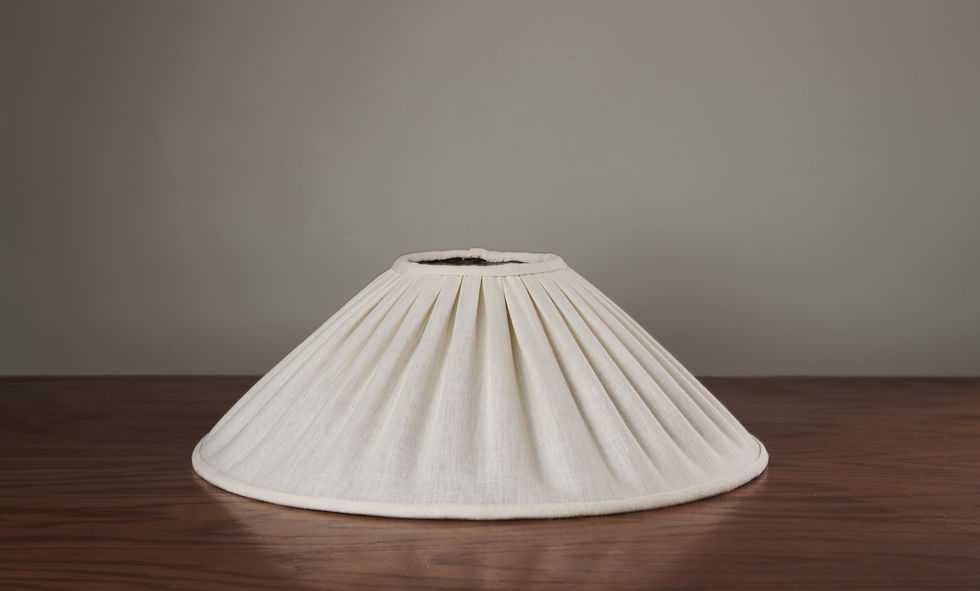
It allows us to determine how a pattern meets at a seam, where a pleat falls, how fabric turns around a scallop, and whether a lining supports the textile without flattening its natural texture. The process takes time, but it also leaves room for the small variations that distinguish work made by hand.
We value that evidence of the maker. Perfection, to us, does not mean erasing it.


Every Detail Has a Reason
A successful fixture is the result of many decisions working together.
Scale, silhouette, textile, trim, proportion, and construction all affect one another. A change to one can alter the balance of the entire piece, which is why these decisions are resolved in relation to the room rather than considered in isolation.
The goal is a finished fixture in which nothing feels arbitrary and everything has found its place.
Where the Story Continues
Every piece eventually leaves the studio, but its story is only just beginning.
It hangs above celebrations and ordinary Tuesday dinners. It welcomes friends at the door, casts light across winter mornings, and marks the end of long days. With time, the brass changes, the textile becomes familiar, and the fixture simply becomes part of home.
That life beyond the studio is the reason we make it.